


Joy by Jean Patou
Women 1930


Main accords
Description
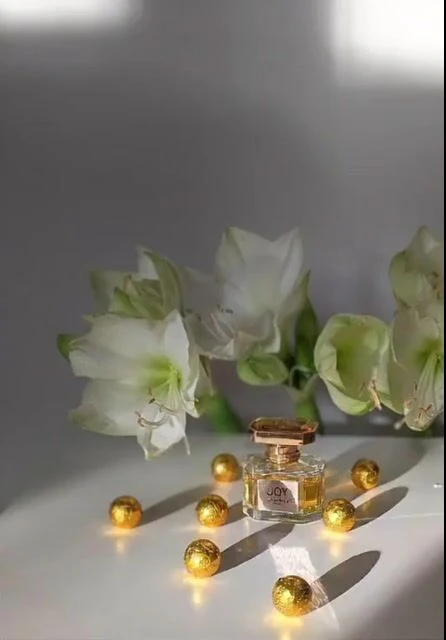
Joy by Jean Patou is a floral fragrance for women. Launched in 1930, this composition was created by perfumer Henri Almeras. The top notes reveal Bulgarian rose, alongside ylang-ylang and neroli; the floral heart is built around jasmine and May rose; while the base notes offer a warm foundation of musk and sandalwood.
Show moreQuick summary
When to wear it (votes)
Key notes
-
Top
 Bulgarian rose (Bulgarian Damask rose)
-
Heart
 jasmine
- Base musk
Community
2,749 votes
- Positive 74%
- Negative 22%
- Neutral 3.7%
The olfactory pyramid
A guide to the opening, heart and lasting trail of the fragrance.


The community speaks
Compare the results and tap an answer to add your vote.
In the collection
Leading answer I own it
7,596 votes
What do you think?
Leading answer Love it
2,749 votes
Season
Choose severalLeading answer Spring
1,668 votes
Time of day
Choose severalLeading answer Night
1,105 votes
Each question has its own vote count. You can choose several seasons.
Fragrance profile
About Joy
Joy by Jean Patou is a floral fragrance for women. Launched in 1930, this composition was created by perfumer Henri Almeras. The top notes reveal Bulgarian rose, alongside ylang-ylang and neroli; the floral heart is built around jasmine and May rose; while the base notes offer a warm foundation of musk and sandalwood.
Flowers White flowers Woods and mosses
It may remind you of
Ranked by what the community voted.


More from Jean Patou


Related editions


More from Henri Almeras


How it wears
Compare the results and tap an answer to add your vote.
Longevity
Leading answer Long-lasting
741 votes
Sillage
Leading answer Moderate
928 votes
Character
Leading answer Traditionally feminine
377 votes
Value perception
Leading answer Fair price
312 votes
You may also like




Community reviews
18 reviews
Share what you noticed: opening, drydown, sillage and the moments when it works for you.
Carmen Salinas admitted it in an interview: it was the scent of Doña María Félix. I am dying to try it one day.
Elegant, floral, and delicious. It transports me to the wild women of the 1930s obsessed with the latest fashion. The most expensive perfume in the world, just as Jean Patou intended for ‘JOY’. A pure feeling of happiness, an olfactory essay. Following the 1929 crisis, Patou and Almeras chose those notes for this elixir. Top notes: Bulgarian rose, ylang-ylang, and neroli. Heart: jasmine and May rose. Base: musk and sandalwood. Designed by Louis Sue, later housed in Bacarat crystal to look even more magnificent. In 1960 it was pirated, much like today with clones. In the 1930s, for 30ml you needed 28 dozen roses and 10,000 jasmine flowers. Only the richest could own it. I detect ylang-ylang, neroli, and magnolias in the opening, with aldehydic and other notes settling as it dries. After 30 minutes, it is a powerful yet delicate symphony. It makes you feel powerful, believe me; on the skin it is sweetness, class, and character. Thank you, Jean Patou, for your creations, including 10,000 and Sublime.
This was the favourite perfume of the Cuban singer Celia Cruz 💞🆗👍
The legendary Joy, the most expensive perfume in the world. It fills me with curiosity; I have only read and heard praise for its complexity and exquisite combination of the finest notes, speaking of quality. It is the scent of the very famous Doña María Félix. I hope one day I can smell that fragrance…
The legendary Joy, the most expensive perfume in the world. A scent that sparks immense curiosity in me; I have only read and heard praise for its complexity and exquisite combination of the finest notes, speaking of quality. This is the perfume worn by the legendary Doña María Félix. I hope one day to be able to experience that fragrance…
A vintage flower shop decorated with gold leaf and much patina. A concept similar to Diorissimo but very different, with a sharper execution on the rose and neroli; more varied in its florals. Both carry jasmine, but here it is surrounded by other flowers. It is a classic florality, very structured, with the natural and wild parts well measured and controlled. I imagine beauty salons or majestic dressing rooms smelling of this. For lovers of vintage floral bouquets, go for Diorissimo and Joy.
This perfume came into my hands thanks to my mother. She was gifted it when she was 20 and, enchanted by the scent, kept the tiny bottle whole. It smells strong and firm; from the first moment it is noticeable and there is no doubt it is Joy. The roses stand out with power without losing the distinctive class and elegance. Ideal for a sensual and confident woman. What a pity it is no longer available and costs a fortune, but lucky to have a full bottle.
This perfume came into my possession through my mother. She was gifted it when she was twenty, and, captivated by the scent, she decided to keep the entire bottle. The fragrance is strong and distinctive; from the moment it is perceived, it commands attention, leaving no doubt that this is Joy. The roses stand out powerfully without losing the class and distinctive elegance of this perfume. A fragrance suited to a sensual, self-assured woman. It is a pity it can no longer be found, but in my case, it is a fortune to still have a full bottle.
I have a bottle from 1983 and also 10,000 and Sublime. The review by La DameDe Noir moved me, and I identify fully with it; little to add. For me, Joy is the least current of the three, less wearable by today’s standards, although they are true jewels. I suppose civet plays a part, just as does the treatment of the rose and jasmine. Accustomed to sugary florals, the sweetness of these flowers (made with the best essential oils to be the most expensive perfume) will cause many to dismiss them, associating them with older women. I clarify that I did not test it on skin, only on blotting paper, as I do not wear feminine perfumes. Joy is absolutely feminine. Now that Chanel No. 5 still sells, Joy is superior, so it should be in shops for everyone to know. It has great presence, abundant quality, and evolves for hours, softening the civet and making the ylang-ylang turn creamy. A historical, mythical floral fragrance, a prototype that lasts for hours; any woman (or man) should know it. A fragrance of good taste, for a woman of class and natural elegance who asserts her status without fuss, kind but with personality. I repeat: 10,000 or Sublime are more popular today, but they do not dethrone Joy as a mythical perfume. An honour to have met you, Joy au revoir!
JOY BY JEAN PATOU Eau De Toilette, or how I collapsed from pure ecstasy. A test of a 2000 edition, in EDT version, which seems from 1930 due to how well-preserved and formulated it is. The fragrance sheet falls short. It is not just floral; it is an aldehydic floral chypre like Chanel No. 5 and Joya, the twins. I love this triumvirate of powerful women. Jean Patou (1887-1936) started with his father, a tanner, and later with his uncle, a furrier, learning design. He entered perfumery in 1925 after the success of Chanel and Poiret. In 1930 he commissioned Henry Almeras to create Joy, a mixture of rose and jasmine in gigantic proportions: over 10,000 jasmine flowers from Grasse and 28 dozen roses from Grasse and Bulgaria for three centilitres. Hence the slogan: ‘Joy, the most expensive perfume in the world’. Later versions were not so luxurious. Joy was based on Chanel No. 5, following the trend of aldehydic florals of the 1920s. Just as there were fougère, aquatic, gourmand, or ambroxan trends, there will always be them. The 2000 Joy is an aldehydic that overwhelms, even though the sheet does not mention them, because if they were included in 2000, in 1930 they must have been a roar. From the start appears a mix of musk, civet, and all the anal, perianal, prostatic, and vesicular glands that exist. That smell of my childhood of ladies who I didn’t know if smelled rich, had bad breath, were out of reach, or had just stepped out of the bathroom without washing. An intense, animal, faecal, parafaecal, halitotic, sensual, sexual, obscene, baroque, sophisticated, and incredibly ravishing scent that drags you to lustful hells without redemption. The smell of sin par excellence. I like it, even if it burns in hell. May God have mercy on my weakness. I thought I could not bear it for years. How we have changed! Today nothing smells like this, and most would find it unbearable. The flowers that define it most are carnation and ylang-ylang, which links it to Chanel No. 5 and Joya. Rose and jasmine are in the background, boosting those two. There is also patchouli and oakmoss. An aldehydic floral chypre can shine with resins like labdanum and turpentine, and woods like lichens and deep mosses. For someone to make a perfume with these notes smell like ambrosia is a mystery. The 2000 test is a classicism of other eras. Its trail and performance are apocalyptic, you cannot move.
I loved it…
I found it in a bazaar, a small test bottle… I loved the scent, like that perfume of old, powerful yet feminine and delicate. I am almost finished with it but it is one of my favourites. A true jewel.
I picked it up at a bazaar, a small tester bottle… I loved the scent, like an old-fashioned perfume, powerful yet feminine and delicate. I’m nearly finished with it and it’s one of my favourites. A true gem.
Joy is pure elegance, one of the few that blends jasmine and neroli without becoming overwhelming. It handles those notes perfectly, unlocking their full potential. It makes us adore civet, those animalic secretions that make it so fascinating to the nose, though I’m sure many won’t share that view. With the peach note, it doesn’t dry out; it stays juicy and sweet without being cloying. Don’t see it as a copy of jasmine; while it bears a strong resemblance, it is far more ambitious. Upon application, green notes, civet, and aldehydes dominate at first. The jasmine is there from the start, but with all that rush of notes, it only settles and gains strength after a few minutes. Towards the end, the rose and valley lily take centre stage. Civet and the green notes persist throughout the fragrance but fade from the outset to make way for others. Simply excellent floral!
Joy is pure elegance, one of the few that blends jasmine and neroli without getting messy. It handles those notes perfectly, bringing out all their potential. It makes us adore the civet, those animal secretions that make it so fascinating to the nose, though I’m sure many won’t take to it. With its peach note, it doesn’t feel dry; it stays juicy and sweet without being cloying. Don’t see it as a copy of jasmine; while it looks very similar, it is far more ambitious. Upon application, the green notes, civet, and aldehydes dominate at first. The jasmine is there from the start, but with all that rush of notes, it only settles and gains strength after a few minutes. Towards the end, the rose and valley lily take centre stage. The civet and green notes persist throughout the fragrance but fade from the start to make way for others. Excellent floral!
And at 957 euros, I reckon you won’t even get a sample!
A super intense fragrance that screams opulence; no wonder they called it ‘the world’s most expensive perfume’. The civeta note is very prominent, but with a floral-aldehydic base, it’s not for delicate noses seeking soft scents. Recommended for women with character, aged 40 and above; it’s a very formal perfume.
Feminine, elegant, floral, innocent… it’s not a sexy scent, but it is utterly delicious. It’s the one that, for me, perfectly encapsulates the image of the classic woman: feminine, as sweet as a flower and so delicate.